
Bluetongue Disease in Camelids
Bluetongue Disease in Camelids
By Scott Noga, Rattlesnake Ridge Ranch, Pasco, WA
Originally published in the Spring 2014 issue of The Journal of The RMLA
[Editors’ Note: For those of you who are signed on to the Llama Chat List, you probably read about the outbreak of Bluetongue Disease in Washington & Montana this Fall. One of our members wrote to the Ask the Vet Column with concerns about this outbreak. We were all set to send this question to CSUVTH when we saw the link to all of Scott Noga’s research. Scott and Gayle Noga lost several llamas to Bluetongue Disease this past Fall. So, with their permission, we have included just a portion of his article. Scott’s intention is to help us understand this disease in camelids and be aware of the symptoms. Please go to www.rattlesnakeridgeranch.com and click on Llama Care for the full article, including references and the farm report. And our thanks to Scott & Gayle for keeping us informed.]
What is Bluetongue Disease?
Bluetongue disease (BT) is a non-contagious, infectious viral hemorrhagic disease affecting primarily domestic and wild ruminants and camelids.
BT can be found just about anywhere in the US. In warmer southerly states the disease is a continual threat but is seasonal in northern climates, typically appearing later in the warm season the further north one gets; late summer and early fall in the most northerly states. It subsides during the winter as adult midges cannot survive in the cold. The survival of the disease past the winter season is due either to midges that survive the winter in a dormant state or seasonal expansion from warmer climates.
Distribution in 2007
It is caused by the Bluetongue virus (BTV), of which there are officially 26 identified serotypes, fifteen of which have been found in the USA, predominantly in the south and four of those appear in the western states. Ten of the fifteen found in the USA appeared after 1997 as the serotypes have expanded their distribution.
The virulence of BTV varies quite markedly; even strains with matching serotypes have variable virulence. The disease is considered non-contagious in that it cannot be transmitted between animals through casual contact, saliva, etc., but instead requires inoculation. The primary vector is blood sucking insects capable of transporting the virus. The primary reservoir of virus in the USA is cattle.

How does Bluetongue Virus Spread?
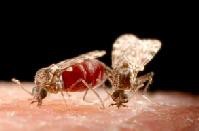
BTV is typically transmitted by biting midges of the genus Culicoides. These flies are small, sometimes referred to as gnats or no-see-ums, only 2-3mm in size prior to engorgement. (They are smaller than the ‘D’ on a dime!) In camelids they typically get into the ears where they reside for hours feeding on blood safe from harm. Other hairless or nearly hairless areas are also vulnerable but exposed areas are not quite as attractive to the flies.
When these flies appear in an area they often do so in large numbers, spreading virus rapidly. Llamas typically flick their ears at the faint sound of these flies, and once in the ears can be very irritating and the llamas may be seen rubbing their heads on objects or the ground occasionally in a vain attempt at relief. A swipe of a finger or thumb inside their ear canal may come out bloody, and you may see the flies trying to escape.
What are the Effects of Bluetongue Disease?
Bluetongue disease is so named because infected animals occasionally develop cyanosis, or blue coloration, of the tongue. Secondary bacterial pneumonia and other opportunistic complications can also develop, sometimes contributing to death in animals that don’t immediately succumb to BTV. Other hemorrhagic diseases such as EHDV have very similar symptoms but species susceptibility varies somewhat. Camelids can also contract EHDV.
In all afflicted animal species, after a prepatent period of typically 3-8 days virus-mediated damage to endothelial cells ensues resulting in vascular thrombosis, tissue infarction, necrosis and internal hemorrhage. In 5 - 20 days symptoms include fever, serous to bloody nasal discharge, congestion, difficulty breathing, excessive salivation, severe pulmonary, intramuscular and subdermal edema, hydrothorax, hydropericardium, myocardial and intestinal hemorrhage, oral erosions and ulcers. The ulcers are typically painful and contribute to anorexia. Diarrhea is commonly seen. Animals become listless and anorexic. Some infected animals exhibit no outwardly obvious symptoms despite internal damage, apart from various degree of lethargy.
Direct cause of death in peracute cases is usually due to frothing from the lungs, sometimes visible in the nostrils, and the accompanying asphyxiation, often before other visible symptoms appear short of listlessness and difficulty breathing. In such cases death can occur in less than six hours of the first appearance of subtly visible unusual behavior such as increased recumbency. Due to the rapidity of such deaths the telltale signs may be missed and the animal(s) mysteriously discovered deceased with no outward causal indications. Such individuals are often disposed of with indeterminate cause of death, leaving owners unaware and vulnerable to expanded suffering and death among their herd. Animals that survive can suffer the effects of organ damage for months or the remainder of their lives.
How is Bluetongue Disease Controlled?
There is no treatment for Bluetongue disease, but it can be controlled through:
- Quarantine Indoors
- Vaccination(where available). The only vaccine approved for use in the USA by the USDA is for BTV-10. California has approved vaccines for BTV-10, 11, 17 in state only. The vaccines are inexpensive and effective for the specific serotype (and ineffective against the many others), but there are potentially serious side effects.
- Vector Control. Midges can be controlled somewhat by preventing midge breeding sites, often cow and horse dung heaps and moist soil, from proliferating.
- Controlling Culicoides sp. at the larval stages typically involves the removal of the breeding Culicoides sp. breed and develop in areas of shallow water, damp areas such as mud, irrigated pasture and marshlands.
- In the adult stage, there are various models of propane powered CO2 traps as well as large fan traps. Modern UV zappers with oscillating light that simulates movement and chemical attractants can be more cost effective. The chemical attractant is designed primarily for mosquitoes, but manufacturers claim it attracts all blood feeding insects at close range, as it mimics breath and sweat scent. The attractant cartridges last for about a month of dusk to dawn use and emit their scent when heated by the lamp.
- Animal Preventive Treatment
- Using topical fly repellant significantly decreases the biting risk from Culicoides sp. The inside ears are the primary target of the midges so are the most important areas to treat. In addition the ears and face, the axilla (armpit) and inguinal (inside of the hind legs) regions may need to be included to cover thinner, more exposed skin. Synthetic pyrethroid products, e.g., Permethrin + Piperonyl Butoxide, are the only ones proven effective against Culicoides. Spray on pyrethroid products need to be reapplied about every three days, though some claim to be effective for a week or more. These products are safe to use, especially topically, as they are non-toxic to mammals.
- Repellents containing DEET (diethytoluamide) provide only limited protection. Note: Some camelids have been observed to exhibit adverse reaction to DEET. Its use is not advised.
- We have tried a fly mask for llamas (custom made), but the llamas that wore it didn’t like to have it on despite the relief it provided from the midges and each managed to eventually rub it off. Contact us for details if you are interested in trying this method.
Conclusion
No single defensive strategy can be relied upon to prevent infection from BTV. All reasonable measures need to be taken to control Culicoides breeding areas, trap adult flies with modern traps, and diligently apply topical synthetic pyrethroid fly repellents throughout BTV season each year.
Even in areas that often see outbreaks of this disease, veterinarians may actually rarely see it and hence may not recognize it when seen. Many animals, cattle particularly, don’t show clear symptoms, usually just reproductive and productive, which vets are not called in for and can be easily dismissed. When other animals such as goats or camelids are found dead of mysterious causes, it’s too late to call the vet so they don’t get contacted. Necropsies are rarely performed. The disease can spread silently, and veterinarians can underestimate the risk.
Like this article? Become a RMLA Member today!

